



- 商品介绍
- 规格参数
- 包装参数
General description
Monoclonal Anti-Mouse Tenascin (rat IgG1 isotype) is derived from the MTn-12 hybridoma1 produced by the fusion of rat myeloma cells and splenocytes from a Lou rat immunized with partially purified mouse tenascin. Human tenascin has three subunits of 190, 200 and 220 kDa. Tenascin has been independently discovered in a variety of species and tissue types, often in the basement membrane or intercellular spaces. It has been described under a variety of names: cytotactin, hexabrachion protein, J1, myotendinous antigen (MI) and glioma mesenchymal extracellular matrix (GMEM). The tenascin molecule is a disulfide-linked hexamer, depending on species, the molecular weights of the subunits range from 190 to 320 kDa.
Tenascin is a high molecular weight, multifunctional, extracellular matrix glycoprotein expressed in association with mesenchymal-epithelial interactions during development and in the neovasculature and stroma of undifferentiated tumors. It has been described under a variety of names: cytotactin, hexabrachion protein, J1, myotendinous antigen (MI) and glioma mesenchymal extracellular matrix (GMEM).
The tenascin molecule is a disulfide-linked hexamer; depending on species, the molecular weights of the subunits range from 190 to 320 kDa. In the mouse, two major subunits of tenascin with an apparent molecular weight of 210 and 260 kDa have been described. The shorter polypeptide predominates during earlier developmental stages and the larger polypeptide appears later in the embryonic gut and especially in the adult intestine. The expression of tenascin is associated with development and growth, both normal and pathological, whereas the distribution in normal adult tissue is restricted. It was proposed that actively growing, migrating and differentiating epithelial sheets can produce factors that can stimulate tenascin expression in the nearby mesenchyme. Human and chicken tenascin contain an RGD sequence which may function in cell adhesion and it seems likely that tenascin mediates cell attachment through an RGD dependent integrin receptor.
Immunogen
partially purified mouse tenascin.
Application
Applications in which this antibody has been used successfully, and the associated peer-reviewed papers, are given below.
Immunohistochemistry (1 paper)
Monoclonal Anti-Mouse Tenascin antibody may be used for the localization of tenascin and to study of the role of tenascin in epithelial-mesenchymal interactions using various immunochemical assays including ELISA, immunoblot, dot blot and immunohistology.
Monoclonal Anti-Tenascin antibody produced in rat has been used in:
- Enzyme linked immunosorbent assay (ELISA)
- Dot blot.
- Immunoblotting
- Fluorescence microscopy and immunostaining
- Immunofluorescence
- Immunohistochemistry
Biochem/physiol Actions
Tenascin is a high molecular weight, multifunctional, extracellular matrix glycoprotein expressed in association with mesenchymal-epithelial interactions during development and in the neovasculature and stroma of undifferentiated tumors. The expression of tenascin is associated with development and growth, both normal and pathological, whereas the distribution in normal adult tissue is restricted. It was proposed that actively growing, migrating and differentiating epithelial sheets can produce factors that can stimulate tenascin expression in the nearby mesenchyme. Human and chicken tenascin contain an RGD sequence motif which may function in cell adhesion and may be recognized by integrin receptor.
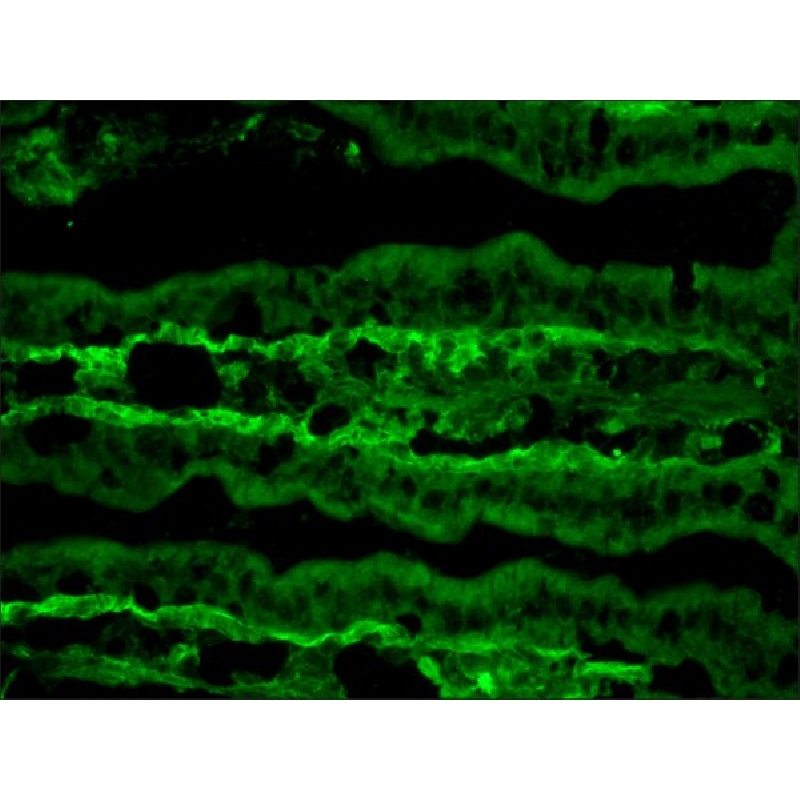
The antibody localizes mouse tenascin in the supernatant of cultured mouse fibroblasts and tissue extracts. No cross-reactivity with tenascin of other species has been observed. In immunohistological testing of frozen tissue sections of mouse intestine, the antibody labels the core of the villi, but not the epithelial cells.
Disclaimer
Unless otherwise stated in our catalog or other company documentation accompanying the product(s), our products are intended for research use only and are not to be used for any other purpose, which includes but is not limited to, unauthorized commercial uses, in vitro diagnostic uses, ex vivo or in vivo therapeutic uses or any type of consumption or application to humans or animals.
| biological source | rat |
| Quality Level | 200 |
| conjugate | unconjugated |
| antibody form | ascites fluid |
| antibody product type | primary antibodies |
| clone | MTn-12, monoclonal |
| contains | 15 mM sodium azide |
| species reactivity | mouse |
| technique(s) | immunohistochemistry (frozen sections): suitable,immunoprecipitation (IP): suitable,indirect ELISA: suitable,indirect immunofluorescence: 1:200 using unfixed, frozen tissue sections of mouse intestine,western blot: suitable |
| isotype | IgG1 |
| UniProt accession no. | Q80Z71 |
| shipped in | dry ice |
| storage temp. | −20°C |
| target post-translational modification | unmodified |
| Gene Information | mouse ... Tnn(329278) |
| 长度(mm) | |
| 宽度(mm) | |
| 高度(mm) | |
| 重量(kg) |
-

¥ 1148.92
-

询价
-

询价
-

¥ 1563.36
-

询价
-

询价
-
询价
-
询价
-
询价
-
询价
-
询价
-
询价
-

¥ 5725.45
-

询价
-
¥ 2268.97
-

¥ 3335.66
-
询价
-
¥ 1156.91
-
¥ 4020.77
-
¥ 1351.48









 微信小程序
7X24小时在线咨询
微信小程序
7X24小时在线咨询