

- 商品介绍
- 规格参数
- 包装参数
General description
Dystroglycan (UniProt: Q28685; also known as Dystrophin-associated glycoprotein 1) is encoded by the DAG1 gene (Gene ID: 100009278) in rabbit. Dystroglycan is a component of the dystrophin glycoprotein complex that serves as an adhesion molecule and links the extracellular matrix to the intracellular actin cytoskeleton. Its expression is reported in the brain, cardiac muscle, skeletal muscle, and placenta. It is synthesized with a signal peptide (aa 1-29) that is subsequently cleaved off to generate the mature protein that is further autolytically cleaved (between 653-654) to produce a-dystroglycan (aa 30-653) and b-dystroglycan (aa 654-895). a-dystroglycan is an extracellular peripheral glycoprotein that binds to several extracellular matrix and synaptic proteins such as laminin-2 and 5, agrin, neurexin, and pikachurin. It is heavily O-glycosylated, which comprises of up to two thirds of its mass and the carbohydrate composition differs depending on tissue type. It is reported that its O-mannosyl glycosylation is required for its ligand- binding functions. b-dystroglycan is a single-pass type 1 transmembrane protein that plays important roles in connecting the extracellular matrix to the cytoskeleton and serves as a cell adhesion receptor in both muscle and non-muscle tissues. In the cell, b-dystroglycan binds to dystrophin that is linked to actin cytoskeleton. Hence, a/b dystroglycans act as a molecular axis connecting extracellular matrix with the cytoskeleton across the plasma membrane. Defects in O-mannosyl glycan have been linked to various congenital muscular dystrophies caused by aberrant a-dystroglycan glycosylation. (Ref.: Kanagawa, M., et al. (2010). J. Biol. Chem. 285(41); 31208-31216; Yamada, H., et al. (1994). FEBS Lett. 352(1); 49-53; Ervasti, JM., and Campbell, KP. (1993). J. Cell Biol. 12(4); 809-823; Ibraghimov-Beskrovnaya, O., et al. (1992). Nature. 355(6362); 696-702).
Immunogen
Rabbit skeletal muscle membrane preparation.
Application
Quality Control Testing
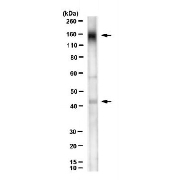
Evaluated by Western Blotting in Rabbit skeletal muscle tissue lysate.
Western Blotting Analysis: 1:1,000 of this antibody detected Dystroglycan in Rabbit skeletal muscle tissue lysate.
Tested Applications
Western Blotting Analysis: A representative lot detected Dystroglycan in Western Blotting applications (Azzag, K., et. al. (2020). Skelet Muscle. 10(1):10 ; Bijata, M., et. al. (2015). Front Cell Neurosci. 9:199).
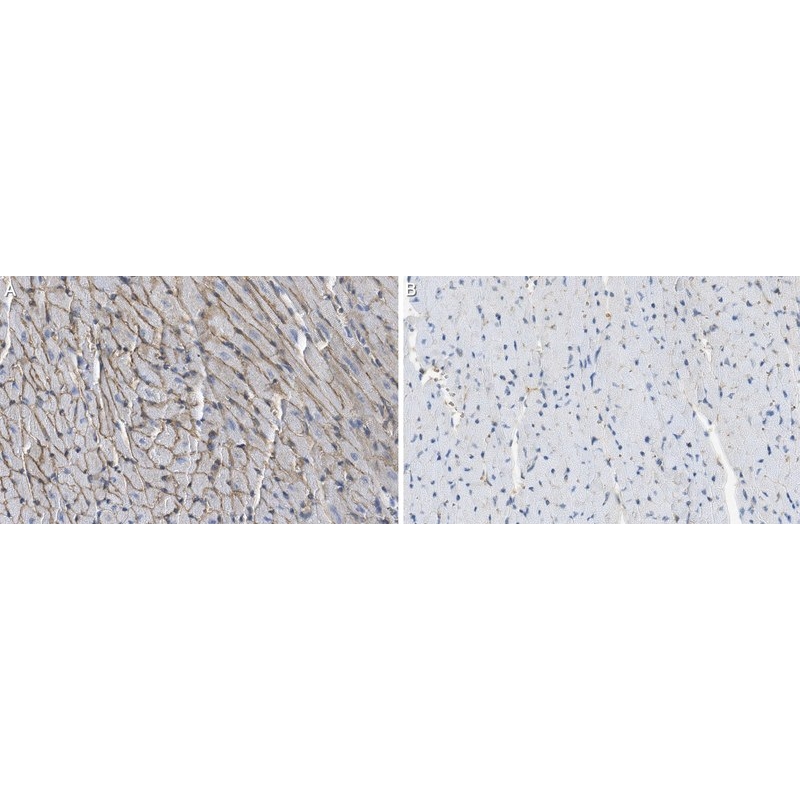
Immunohistochemistry (Paraffin) Analysis: A 1:50 dilution from a representative lot detected Dystroglycan in mouse heart and mouse skeletal muscle tissue sections.
Flow Cytometry Analysis: A representative lot detected Dystroglycan in Flow Cytometry applications (Gerin, I., et. al. (2016). Nat Commun. 7:11534).
Immunofluorescence Analysis: A representative lot detected Dystroglycan in Immunofluorescence applications (Azzag, K., et. al. (2020). Skelet Muscle. 10(1):10).
Inhibition Analysis: A representative lot reduced agrin-induced ERK activation in cardiac cells. (Bassat, E., et. al. (2017). Nature. 547(7662):179-184)
Immunohistochemistry Applications: A representative lot detected -Dystroglycan in Immunohistochemistry applications (Cataldi, M.P., et. al. (2018). Nat Commun. 9(1):3448).
Immunocytochemistry Analysis: A representative lot detected Dystroglycan in Immunocytochemistry applications (Bijata, M., et. al. (2015). Front Cell Neurosci. 9:199).
Note: Actual optimal working dilutions must be determined by end user as specimens, and experimental conditions may vary with the end user
Anti-a-Dystroglycan, clone IIH6C4, Cat. No. 05-593-I, is a mouse monoclonal antibody that detects Dystroglycan and is tested for use in Flow Cytometry, Immunocytochemistry, Immunofluorescence Inhibition, Immunohistochemistry, and Western Blotting.
Biochem/physiol Actions
Clone IIH6 (IIH6C4) is a mouse monoclonal antibody that detects Dystroglycan (a-Dystroglycan and uncleaved form) in multiple species.
Physical form
Mouse monoclonal antibody, culture supernatant withoutazide.
Preparation Note
Stable for 1 year at -10°C to -25°C from date of receipt. Handling Recommendations: Upon receipt and prior to removing the cap, centrifuge the vial and gently mix the solution. Aliquot into microcentrifuge tubes and store at -20°C. Avoid repeated freeze/thaw cycles, which may damage IgG and affect product performance.
Other Notes
Concentration: Please refer to guidance on suggested starting dilutions and/or titers per application and sample type.
Disclaimer
Unless otherwise stated in our catalog or other company documentation accompanying the product(s), our products are intended for research use only and are not to be used for any other purpose, which includes but is not limited to, unauthorized commercial uses, in vitro diagnostic uses, ex vivo or in vivo therapeutic uses or any type of consumption or application to humans or animals.
| biological source | mouse |
| Quality Level | 200 |
| conjugate | unconjugated |
| antibody form | unpurified |
| antibody product type | primary antibodies |
| clone | IIH6 (or IIH6C4), monoclonal |
| mol wt | calculated mol wt 97.03 kDa,observed mol wt ~43 and 156 kDa |
| species reactivity | rabbit, human, mouse |
| species reactivity (predicted by homology) | guinea pig, canine, rat |
| packaging | antibody small pack of 100 μL |
| isotype | IgM |
| UniProt accession no. | Q28685 |
| shipped in | dry ice |
| storage temp. | -10 to -25°C |
| target post-translational modification | unmodified |
| Gene Information | rabbit ... DAG1(100009278) |
| 长度(mm) | |
| 宽度(mm) | |
| 高度(mm) | |
| 重量(kg) |
-
¥ 2528.88
-
询价
-
¥ 1683.78
-
¥ 1302.89
-
询价
-
询价
-
¥ 8520.40
-
询价
-
询价
-
询价
-
¥ 3372.68
-
询价
-
¥ 2882.02
-
¥ 2307.00
-
¥ 1476.40
-
¥ 9909.51
-
 NNALGENE 180透明塑料管,透明,柔软,多用,经济,内径 x 外径x壁厚,1/4 x 1/2 x 1/8,英寸,每箱数量50,50/箱,8000-0080,Thermofisher,赛默飞世尔
询价
-
¥ 44224.19
-
¥ 18741.69
-
¥ 29754.56









 微信小程序
7X24小时在线咨询
微信小程序
7X24小时在线咨询